
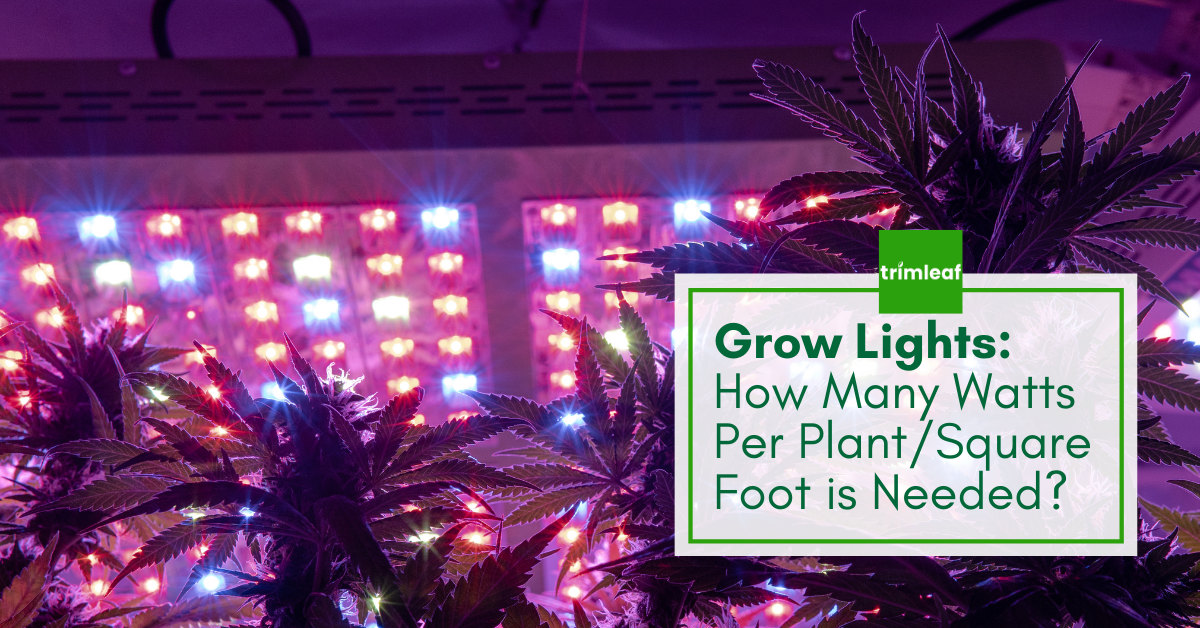
One of the most common questions from growers setting up an indoor space: How many watts per plant do LED grow lights need? The answer isn't just a number. It depends on your grow stage, tent size, and fixture efficiency. Unlike HPS systems, modern LED fixtures operate by different rules, and understanding the wattage-to-area relationship is crucial for maximizing yields without wasting electricity.
For the full picture on LED fixture selection, sizing, and brand comparisons, the complete LED grow light buying guide walks through every major fixture line.
Table of Contents
- The Short Answer: Watts Per Plant and Per Square Foot
- Why Watts Per Plant Matters Less Than PPFD
- Calculating Wattage for Your Grow Space
- Watts Per Plant: A Secondary Metric
- Fixture Efficiency: The Real Differentiator
- Heat, Cooling, and Electricity Costs
- Common Mistakes When Choosing Wattage
- Recommendations by Crop Type
- Frequently Asked Questions

The Short Answer: Watts Per Plant and Per Square Foot
For LED grow lights:
- Vegetative stage: 25–35W per square foot (or 1–2W per plant in soil/hydro)
- Flowering stage: 40–50W per square foot (or 3–5W per plant for dense canopies)
- Seedlings/clones: 10–20W per square foot (lower intensity reduces light stress)
These ranges assume modern quantum boards or bar-style LEDs with 2.0–2.5 µmol/J efficiency. Older or poorly designed LEDs may need 20–30% more wattage to achieve the same results.
Why Watts Per Plant Matters Less Than PPFD

Raw wattage is a poor predictor of light quality. A 600W fixture from one brand might outperform an 800W fixture from another due to differences in:
- Spectrum efficiency: Which wavelengths are included and in what ratios
- Optical design: How evenly light spreads across the canopy
- Electrical efficiency: µmol/J (photons delivered per joule consumed)
PPFD (Photosynthetic Photon Flux Density, measured in µmol/m²/s) is the real metric that drives growth. Target PPFD by stage:
- Seedlings: 200–300 µmol/m²/s
- Vegetative: 500–800 µmol/m²/s
- Flowering: 800–1200+ µmol/m²/s (depending on crop)
Always compare fixtures by their PPFD maps, not just wattage. A 400W LED with excellent optics can deliver more usable light than a 600W budget fixture.
Calculating Wattage for Your Grow Space

Use this formula as a starting point:
Note: These ranges assume modern full-spectrum LEDs. If you're upgrading from HPS, reduce your expected wattage by 30–40%. LEDs are far more efficient.
Watts Per Plant: A Secondary Metric
For soil or passive hydro systems, you can also think in terms of watts per plant:
- Vegetative: 1–2W per plant (depending on spacing)
- Flowering: 3–5W per plant (denser canopies need more light)
- Clones/seedlings: 0.5–1W per plant
This metric breaks down in large commercial setups where hundreds of plants sit under a single fixture, but it's useful for small hobby growers estimating how many plants fit under a given light.
Fixture Efficiency: The Real Differentiator
Modern quantum boards and bar-style LEDs deliver 2.0–2.5 µmol per joule of electricity consumed. This means:
- A 600W fixture producing 2.5 µmol/J delivers 1,500 µmol/s total output
- An older fixture at 1.8 µmol/J delivers only 1,080 µmol/s for the same power draw
Higher efficiency means lower electricity costs and more light for your plants. Brands like HLG, Gavita, and high-end Spider Farmer models lead here.
Heat, Cooling, and Electricity Costs
LED fixtures convert 15–20% of power to heat (the rest becomes light). A 600W fixture generates 90–120W of heat:
- Passive cooling (heatsinks alone) works for fixtures under 400W in well-ventilated spaces
- Active cooling (fan + controller) is essential for 600W+ fixtures
- Target a 5–10°F rise above ambient with proper airflow (4–6 air changes/min)
Operating cost at 15 hours/day and $0.12/kWh:
- 400W fixture: $22/month
- 600W fixture: $33/month
- 1000W fixture: $55/month
Common Mistakes When Choosing Wattage
1. Focusing only on wattage, not PPFD: A 500W fixture with poor optics underperforms a 400W with excellent design. Always request PPFD maps.
2. Undersizing for flowering: Many growers use veg-level wattage through flower. Flowering requires 40–50% more light than veg for maximum yield.
3. Ignoring efficiency ratings: A 2.0 µmol/J fixture needs 20% more wattage than a 2.5 µmol/J model to achieve the same growth.
4. Not accounting for fixture degradation: LED output declines ~3–5% per year. A fixture rated for 1200 µmol/s at year 1 drops to ~1100 µmol/s by year 2. Choose slightly higher wattage than your minimum requirement.
5. Neglecting heat management: Undersizing cooling leads to temperature stress, which cuts photosynthetic efficiency by 30–50%.
Recommendations by Crop Type
Vegetables (tomatoes, peppers, lettuce): 40–50W per sq ft for fruiting crops; 25–35W for leafy greens.
Cannabis/high-light crops: 50–60W per sq ft for maximum yield (requires excellent cooling).
Herbs (basil, cilantro): 20–30W per sq ft (lower light needs).
Seedlings/propagation: 10–20W per sq ft (avoid light stress, prefer blue-heavy spectrum).
Frequently Asked Questions
- Can I use a 1000W LED over a 4x4 tent, or is that overkill?
No, it's perfect. A 1000W fixture over 4x4 delivers industry-standard intensity (1200–1400 µmol/m²/s at flowering canopy level). You can reduce intensity by raising the light 24+ inches or using dimming (if the fixture is dimmable), making it ideal for both veg and flower phases.
- How do I know if my fixture is efficient enough?
Check the µmol/J rating (efficiency). Anything above 2.0 is good; 2.2+ is excellent. If the manufacturer doesn't list this, ask for it. Also request a PPFD map showing intensity at 18, 24, and 30 inches above the canopy.
- What's the difference between watts per plant and watts per square foot?
Watts per plant depends on spacing and canopy density. In a dense 3x3 with 9 plants, you might run 400W (44W per plant). In a sparse 4x4 with 4 plants, 1000W gives 250W per plant, but PPFD per plant is what actually matters. Focus on PPFD targets by stage, then calculate wattage from there.
- Should I buy a dimmable fixture?
Yes, if budget allows. Dimmable fixtures let you reduce intensity for seedlings, propagation, and early veg without wasting power. The 10–15% premium is worth the flexibility.
- How do I calculate wattage for a non-standard tent size?
Use the watts-per-square-foot formula. For a 3x4 tent (12 sq ft) in flower, multiply 12 × 45W = 540W needed. Choose the nearest fixture size: a 600W will be ideal; a 500W will be tight but workable if efficient.
- Can I use two 300W fixtures instead of one 600W?
Yes, but it's more complex. Two fixtures require separate hangers, more wiring, and dual cooling coordination. A single 600W is simpler and usually cheaper. Two fixtures shine if you want modular expandability or need to light two separate zones.
- What's the lifespan of an LED fixture?
Quality LEDs last 50,000–100,000 hours (5–10 years of daily use) with minimal output decline. Budget and midrange fixtures may degrade faster. Always check the manufacturer's warranty.
Next Steps
Match your fixture to your grow space using the wattage tiers above: the full LED grow light range is filtered by wattage so you can jump straight to your square footage. For brand-by-brand efficiency and PPFD comparisons, the complete LED grow light buying guide breaks down every major fixture line. If you are matching light to a specific crop, the best grow lights by use case guide covers vegetables, herbs, and high-light flowering crops.


